At a glance
- From: Czech Republic, Germany and Poland (a co-production)
- Year: 2025
- Length: about 128 minutes
- Language: Czech and German, with subtitles
- For fans of: The Lobster, Being John Malkovich, Kafka’s own stories
The film opens with a boy getting a haircut. His father, a domineering man, is the one with the scissors. The boy is Franz Kafka, the writer whose name gave us the word “Kafkaesque”, for a situation that is absurd and nightmarish.
Franz does not follow the usual rules of a biography. It is a collage of scenes: Kafka’s life in Prague from his birth in 1883, his father, his office work, his engagements, his illness and his death in Berlin in 1924. The scenes jump forward and back in time. His sister Ottla looks at the camera and tells part of the story. Then the film jumps to today’s Prague, with the Kafka Museum, tourists taking selfies at a lake and a Kafka themed burger restaurant. One critic was not sure whether these scenes make fun of the Kafka business or only show how strange it is.
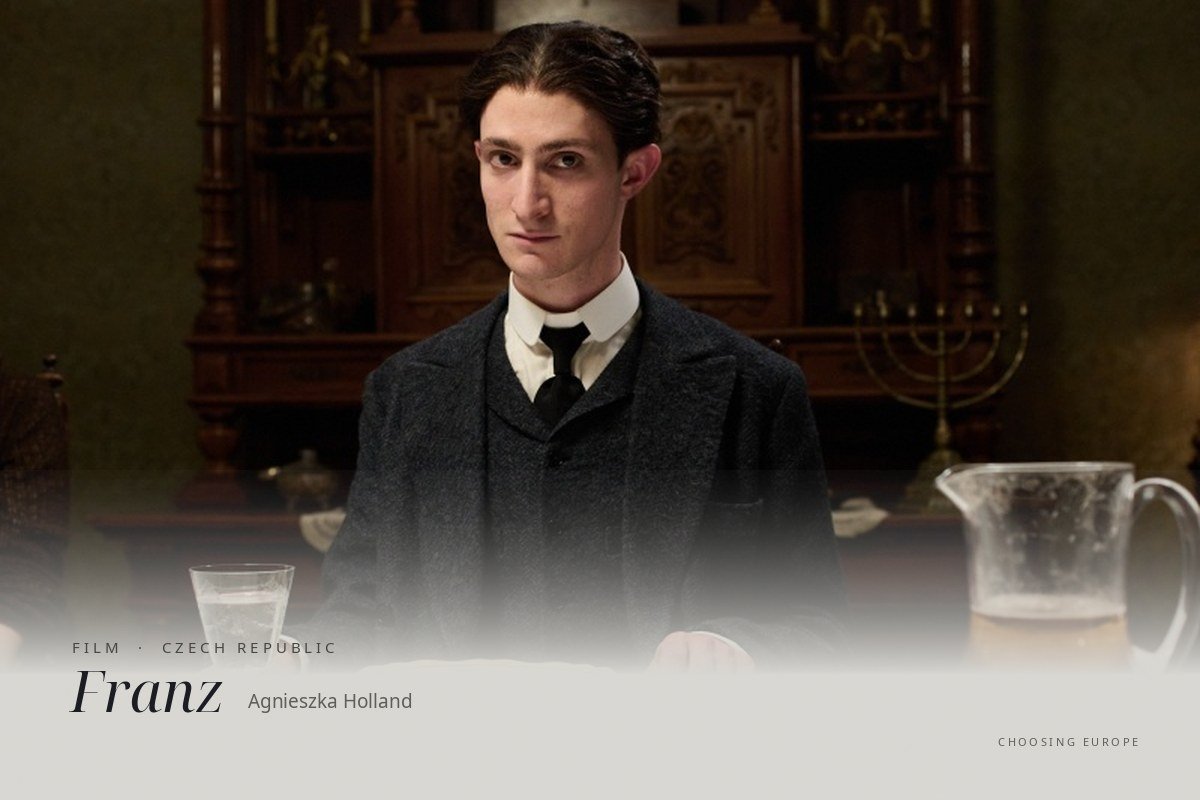
Idan Weiss plays Kafka with a quiet, serious face. Jenovéfa Boková plays Milena Jesenská, his translator and lover. The film ends with Max Brod, the friend who refused to burn Kafka’s papers, as Kafka had asked him to do.
The director is Agnieszka Holland, who was born in Warsaw, studied film in Prague and speaks fluent Czech. She also made Charlatan (2020) and Green Border. The screenplay is by Marek Epstein, who wrote Charlatan. Filming took about 40 days in Prague and Berlin, in the spring of 2024.
Critics were divided. Screen Daily found it an interesting portrait, but “not entirely successful”, and thought it says more about Holland than about Kafka. IndieWire was much harsher, and called it a failure. Roger Ebert’s website, on the other hand, liked its modern, playful approach. In March 2026, it won four Czech Lion awards, including Best Actor for Idan Weiss, and it was the most awarded film of the night. If you want a clear, step by step biography, this is not the film. If you like Kafka’s strange logic, it is a good fit.
If you do not know Kafka, it helps to read his very short story “A Hunger Artist” first, or the first pages of The Trial.
If you like this, try these from Europe
- Charlatan 🇨🇿: by the same director and screenwriter. The story of a Czech healer, which won the Czech Lion for Best Film.
- Stefan Zweig: Farewell to Europe 🇦🇹🇩🇪🇫🇷: the last years of another great Central European writer, who left Europe because of the war.
- Hannah Arendt 🇩🇪: the philosopher, played by Barbara Sukowa, reports for The New Yorker on the trial of the Nazi official Adolf Eichmann.
Where to find it in Europe
- In Spain: on Filmin, a Spanish streaming service for independent cinema, under the title Franz Kafka.
- In France: to rent on ARTE VOD, under the title Franz K.
- In Poland: on Canal+ and to rent on TVP VOD, the service of the public broadcaster, under the title Franz Kafka.
- In Germany: to rent or buy on several services, and on DVD and Blu-ray.
- In the Czech Republic: it is on Netflix and HBO Max at the moment.
- Other countries: check your local cinema, your public broadcaster and the services above. The international sales agent is Films Boutique.
The European context
Franz Kafka was born in Prague, wrote in German and lived in a city that was then part of the Austro-Hungarian empire. The film comes from the same mix of countries: the Czech Republic, Germany and Poland, with support from Eurimages, the film fund of the Council of Europe, and from ZDF/ARTE.
Watch the trailer: https://youtu.be/q9e3FdvYQZs
Also on Choosing Europe
- Film: The Peasants (Chłopi) 🇵🇱: another film from Poland, painted in oil and based on a Nobel Prize novel.
- Film: Quisling: The Final Days (Quislings siste dager) 🇳🇴: another European film about a real person and a difficult part of history.