At a glance
- From: The Document Foundation, a non-profit in Berlin, Germany
- Latest version: LibreOffice 26.8, announced on 26 August 2026
- Price: free to download and use, with no subscription and no account
- Works on: Windows, macOS and Linux, in 120 languages
- An alternative to: Microsoft 365 and Google Docs
Choosing Europe is planned in a spreadsheet. Every pick, every date and every flag lives in one file, and that file was made with LibreOffice. We never paid for it, and nobody asked us to create an account.
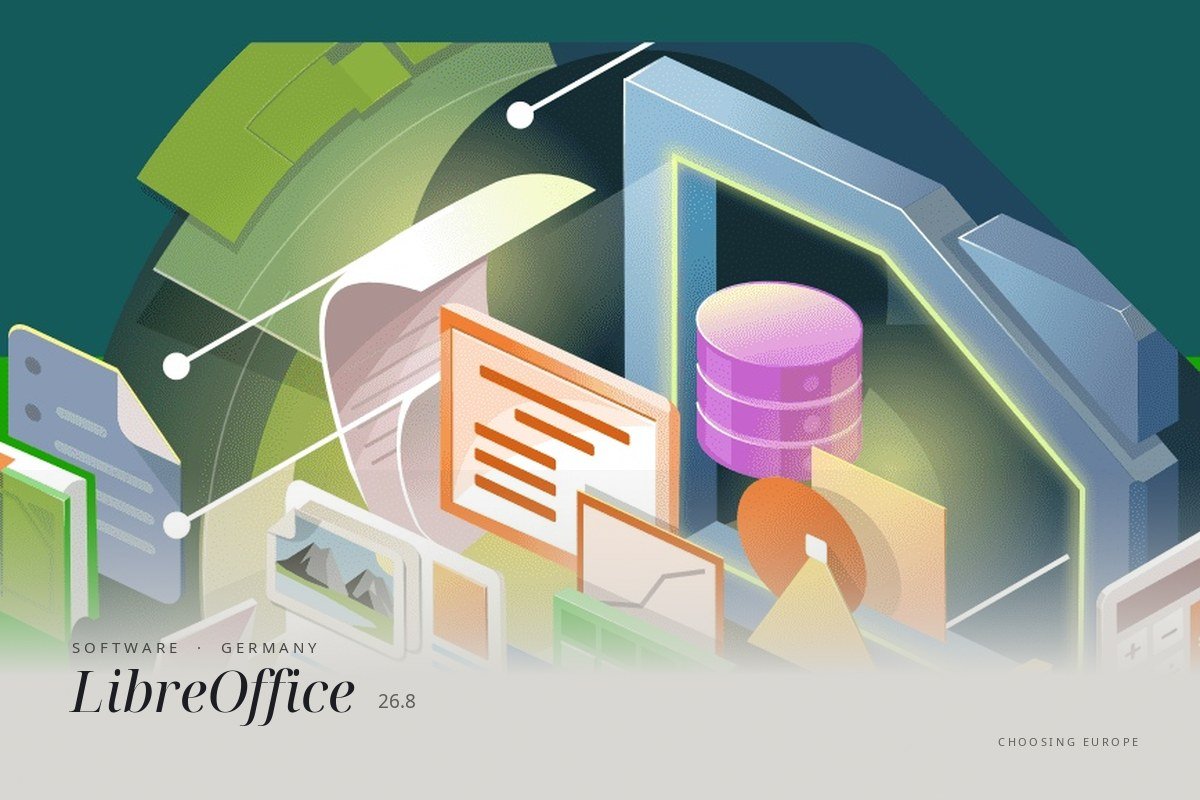
LibreOffice is a complete office suite. Writer is for text, Calc for spreadsheets and Impress for presentations, and there are also Draw, Base and Math. It can work with Microsoft Office files. Its own format, ODF (OpenDocument Format), is an open standard that does not belong to any company.
The Document Foundation was announced in September 2010 by members of the OpenOffice.org community, to develop LibreOffice without the control of one company. It is a non-profit based in Berlin. The newest version was made by 206 people, and 155 of them are volunteers. But people and code are not the same thing. In the last year, according to the project’s own report, volunteers wrote about 22% of the code changes. The rest was written by paid developers, from The Document Foundation itself and from companies such as Collabora that sell support for LibreOffice.
Version 26.8 has one detail that says a lot: the project says it contains no generative AI features. Your documents are not sent to outside services, and the suite does not need an internet connection to work. The project also says it has no ads, no telemetry and no subscriptions. For an office program in 2026, that is unusual, and for many people it is very welcome.
LibreOffice is free, but be careful where you download it. The versions in the Microsoft Store and the Apple App Store cost money, because the publisher uses that income to maintain those versions. The software is the same as the free one on the official website. As with any program that opens files made by another program, very complex Word or PowerPoint files can look a little different.
Governments are paying attention too. In 2025, Denmark’s Ministry of Digitalisation started to move its staff from Microsoft Office to LibreOffice, to depend less on US technology companies. The German state of Schleswig-Holstein is moving about 30,000 public sector computers to open source software, with LibreOffice included.
Where to start
Download it and open a file you already use, ideally a spreadsheet. Work with it for a week before you decide. Then try one thing: save a document in ODF (.odt for text, .ods for spreadsheets). It is an open format that any program can implement, so your files do not depend on one company.
If you like this, try these from Europe
- Nextcloud Office 🇩🇪: from Nextcloud, a company in Stuttgart. Documents you can edit together in the browser, on your own cloud.
- CryptPad 🇫🇷: documents, spreadsheets and forms in the browser, encrypted so that the server never holds the keys. It is made by XWiki, a company in Paris.
- Proton Drive 🇨🇭: encrypted file storage from the Swiss company Proton, with its own documents and spreadsheets.
Where to find it in Europe
- Download it: free from the official website, for Windows, macOS and Linux.
- In the browser: Collabora Online is built on LibreOffice and is one of the office suites offered inside Nextcloud. Its company, Collabora Productivity, has offices in Cambridge (UK) and Hamburg (Germany).
- Give something back: the project asks for donations to keep going.
The European context
LibreOffice is coordinated by a non-profit in Berlin and developed in the open by a mix of volunteers and paid developers from several European companies. When a government office such as the Danish ministry changes its software, it shows that there is a choice.
Official website: https://www.libreoffice.org/
Read about the new version: https://blog.documentfoundation.org/blog/2026/08/26/libreoffice-26-8/
Also on Choosing Europe
- Phone: Volla 🇩🇪: another German product for people who want more control over their data.
- Phone: Mudita 🇵🇱: a calm phone, for people who want technology to ask for less of their attention.
Updated on 15 October 2026. A reader pointed out that saying most contributors are volunteers could suggest that most of the work is unpaid. We added that volunteers wrote about 22% of the code changes between October 2025 and September 2026, and that the rest came from paid developers (State of the LibreOffice Project).