Technical clothing beyond the global brands
There is a well-known observation about pregnancy. Once you or someone close to you is expecting, you suddenly notice pregnant women everywhere. Not because there are more of them. Because you are paying attention.
The same happens when you buy a new car. From that moment, you see the exact model on every street corner. The city has not changed. Your awareness has.
Something similar seems to be happening across Europe right now. Signals are appearing everywhere. Conversations about digital sovereignty, industrial autonomy, military self-reliance, and commercial independence are no longer confined to policy documents. They are showing up in daily decisions, in consumer choices, in the language people use when they talk about where things come from and who controls them.
It is not that these things are new. It is that we are paying attention. And when you start paying attention, the signals come through more clearly and more often.
This newsletter is part of that shift. Each edition is a small step towards making more aware purchasing decisions.
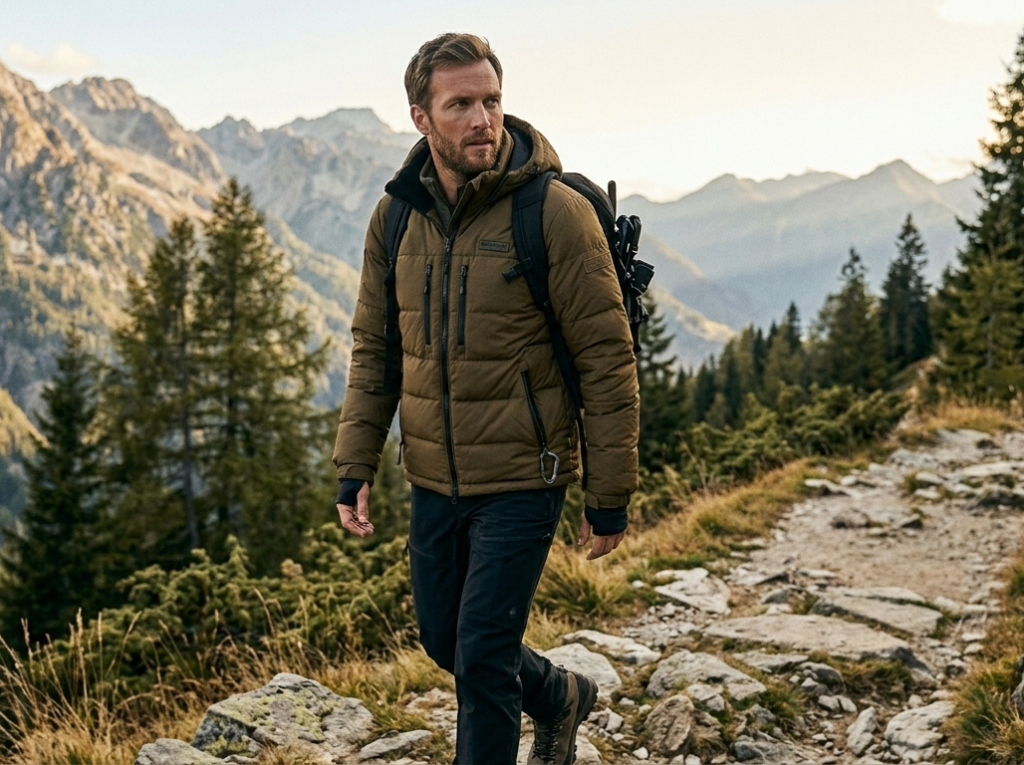
This week, we turn to the market for outdoor clothing, which is dominated by American brands, but which is also supported by a European industrial tradition that deserves to be recognised.
Thanks for reading Choosing Europe! Subscribe for free to receive new posts and support my work.
In this issue
💡 Focus Beyond the logo. Selecting European outdoor clothing built for real conditions, honest engineering, and the long term.
📖 Book The Deserters (Déserter) · Mathias Énard · France 🇫🇷 (2023) A novel about war, memory, and the weight of the last century. Longlisted for the International Booker Prize 2026.
🎬 Film Society of the Snow · Spain 🇪🇸 (2023) A survival film that stays on the mountain and inside the cold. Goya Award for Best Film.
📺 Series Families Like Ours (Familier som vores) · Denmark 🇩🇰 (2024) Thomas Vinterberg’s television debut. What happens when a wealthy European country becomes the refugee crisis.
🎵 Music Ich Lieb Mich Ich Lieb Mich Nicht · Nina Chuba · Germany 🇩🇪 (2025) The most streamed German-language artist of her generation. Number one in Germany and Austria.
🎙️ Podcast Café Europa · Portugal 🇵🇹 A weekly Portuguese podcast on European affairs, diplomacy, and the future of the continent.
A small side note
If you are still using Microsoft Office, you might want to consider LibreOffice.
LibreOffice is free, open source, and developed by a European foundation based in Berlin. It reads and writes all the same file formats, and the manufacturing process is entirely transparent. 🇪🇺
Choosing European Outdoor Clothing 🏔️
The outdoor clothing market in Europe reached 18 billion dollars in 2023. Most of that spending flows towards a small group of American brands.
The North Face, Patagonia, Columbia, and Arc’teryx dominate shelf space, social media, and the visual identity of outdoor retail across the continent.
These brands built their reputations on genuine technical innovation.Many of their high-end lines still reflect that heritage. But the bulk of their revenue now comes from products positioned somewhere between performance and lifestyle, designed for visibility as much as function, and manufactured in Asia at volumes that make close quality oversight difficult.
European alternatives exist at every level of the market. Some are well known. Others operate quietly in niches where the primary audience is professional guides, competitive athletes, and experienced mountain users who prioritise function over brand recognition.
What follows is a clear account of both groups, separated by where the product is actually made.
Producing technical outdoor apparel in Europe is significantly more expensive than producing it in Asia. Most brands have moved the majority of their manufacturing offshore over the past three decades.
What it does mean is that the distinction between a brand that is European in ownership and design and a brand that also manufactures in Europe is a meaningful one. Both can produce excellent technical clothing.
Choosing Europe is a newsletter about conscious purchasing decisions in favour of the European industrial ecosystem. We have no commercial relationships with any brand mentioned in this publication.
Our European Choice
Tilak · Czech Republic 🇨🇿
Founded in 1986 in Šumperk, in the foothills of the Jeseníky mountains, by a climber who could not find technical clothing he trusted. Everything Tilak produces is still made in the Czech Republic. They are the only Czech manufacturer licensed by W.L. Gore to use Gore-Tex across their range, and they back every product with a four-year guarantee. Their Poutnik collection, developed in collaboration with Errolson Hugh, the designer behind ACRONYM, has earned them a serious following in Japan and North America. The Czech textile industry carries generations of accumulated craft knowledge. Tilak is one of the clearest examples of that knowledge applied to contemporary technical performance.
Löffler · Austria 🇦🇹
Based in Ried im Innkreis in Upper Austria, Löffler has produced performance apparel continuously since 1968. Their focus is the technical end of cycling, cross-country skiing, triathlon, and mountain sports. Their Transtex fabric system manages moisture through a layered construction refined over decades in a single workshop. Production in Austria means compliance with some of the strictest labour and environmental standards in the European Union. The brand is not widely distributed in mainstream outdoor retail, which is partly a consequence of the cost structure that comes with European manufacturing and partly a reflection of their priorities.
Ferrino · Italy 🇮🇹
Founded in Turin in 1870, Ferrino is one of the oldest outdoor brands in continuous operation anywhere in the world. The company is still owned by the fifth generation of the founding family. Their high-performance tents and sleeping bags have been used on major Himalayan expeditions, and the brand supplies the United Nations, the Red Cross, and Italian Civil Protection. Part of their high-end range is produced in their original Turin factory. Their CEO, Anna Ferrino, received the Compasso d’Oro lifetime achievement award in June 2024, Italy’s highest recognition for design excellence. A 155-year-old family company manufacturing in the city where it was founded is a genuinely rare industrial fact.
European owned, manufactured globally
The brands in this section are European in ownership, governance, and design culture. Their technical standards are genuine. Their manufacturing is primarily in Asia. For buyers who prioritise supporting European capital and design expertise, these are strong choices. For buyers whose primary concern is where the product is stitched, the distinction from the previous group is real.
Norrøna · Norway 🇳🇴
A family business since 1929, still owned and run by the fourth generation of the Jørgensen family from Oslo. Norrøna was the company that introduced Gore-Tex to the European market. Their collections are named after specific Norwegian locations where each line was developed and tested under real conditions. Lofoten for Arctic freeride skiing. Trollveggen for climbing. Falketind for alpine mountaineering. The company is famous for its heavy investment in research. About 90 percent of their products are developed in-house at their headquarters in Norway. While the capital, design and decision making are 100 percent Norwegian, their manufacturing takes place primarily in Asia to meet global demand.
Mammut · Switzerland 🇨🇭
Founded in 1862 as a rope manufacturer in the Swiss canton of Aargau, Mammut is among the oldest technical mountain equipment companies still operating. Their Eiger Extreme collection is developed with elite alpinists who climb the north face of the Eiger in winter conditions. The brand was acquired in 2021 by Telemos Capital, a European family office with declared roots in Zurich. Manufacturing is global, with around 67 percent of revenues coming from Europe. Mammut has been a member of the Fair Wear Foundation since 2008 to ensure good working conditions. They have also worked hard to remove harmful PFAS chemicals from all their products by 2025.
Salewa · Italy 🇮🇹
Founded in Munich in 1935 and relocated to Bolzano in 1990, Salewa operates from the South Tyrol under the Oberalp Group, a family company owned entirely by the Oberrauch family. Oberalp also owns Dynafit, the global reference for ski touring equipment, and Wild Country for climbing hardware. Design and product development happen in Bolzano. The TirolWool initiative sources wool from native Brillenschaf sheep bred a few kilometres from the company’s offices. Manufacturing is in Asia with Fair Wear Foundation certification.
Helly Hansen · Norway 🇳🇴
Founded in 1877 in Moss by a Norwegian sea captain, Helly Hansen spent its first century as a genuinely Norwegian company. That changed in 1997 when the investment group Investcorp acquired it. By 2012 the Ontario Teachers’ Pension Plan had taken majority control, shifting the capital base to Canada. In 2018, Canadian Tire Corporation completed the current ownership picture, purchasing the brand for 985 million Canadian dollars.
The reason it still appears in this section is straightforward. Design, product development, and headquarters remain in Oslo. Their Lifa base layer technology and Helly Tech membrane are genuine engineering contributions developed over decades of professional use in Nordic marine and mountain conditions. The brand still thinks in Norwegian terms even if the financial returns flow to Toronto.
Rab · United Kingdom 🇬🇧
Founded in Sheffield in 1981 by climber Rab Carrington, who needed down insulation capable of surviving the routes he was attempting. Still independently owned by Equip Outdoor Technologies, with annual revenues around 120 million pounds. Rab maintains one production facility in the United Kingdom alongside their Asian supply chain, which is unusual at this scale. Their down sleeping bags and insulated shells are standard equipment among professional guides and high-altitude mountaineers. Two products from a single Rab collection were selected by the ISPO jury in 2024.
Haglöfs · Sweden 🇸🇪
Over a century of Swedish outdoor heritage, founded in 1914 in the forests of Dalarna. Design and development remain in Stockholm, where the brand has signed a move to the Slakthusområdet district for autumn 2026, a former industrial quarter being repurposed into a creative and design hub. In December 2023, ASICS sold the brand entirely to LionRock Capital, a Hong Kong firm with close ties to the Chinese sportswear group Li-Ning. The capital is now Asian. The design culture is still Swedish, and the L.I.M Intense Trail Hybrid Jacket won the Apparel Award at the Scandinavian Outdoor Awards in 2024.
Making the choice
The brands described here are not asking you to compromise on performance. They are asking you to direct the same budget towards companies that still carry their technical knowledge inside a European industrial framework, whether that is a workshop in the Czech Republic, a family factory in Turin, or a design office in Oslo that has been solving the same alpine problems for nearly a century.
Industrial capacity of this kind is slow to build and quick to lose. Buying from the brands that maintain it is the most direct way to keep it alive.
The cultural recommendations for this issue follow below.
🎬 Films
Society of the Snow (La sociedad de la nieve) · Spain 🇪🇸 (2023)
In October 1972 a chartered flight carrying a Uruguayan rugby team crashed in the Andes. What followed was seventy two days on a glacier at 3600 metres with no rescue coming.
Director J.A. Bayona tells the story without Hollywood spectacle. He stays close to the cold, the waiting and the difficult decisions the survivors had to make to stay alive. It is one of the most physically honest survival films made in recent years. The film was selected as the Spanish entry for the Academy Awards and won the Goya for Best Film.
If you want more
- The Big Fake (Il falsario) · Italy 🇮🇹 (2025): A young painter arrives in Rome during the 1970s with nothing but his talent. He ends up becoming the most in demand forger in the city, working simultaneously for art galleries, the mafia and the secret services. The story is based on real events and is set against the political violence of the Years of Lead in Italy.
- Transamazonia (Transamazonia) · France and Germany 🇫🇷🇩🇪 (2024): This drama is set at the crossing point of personal faith and environmental destruction in the Amazon rainforest. The story refuses to make either side comfortable. It follows the tension between local religious conviction and global ecological consequences with unusual restraint.
- The Peasants (Chłopi) · Poland 🇵🇱 (2023): This beautiful film is animated entirely in oil paint on canvas. It is based on the Nobel Prize winning novel by Władysław Reymont. The story explores a rural community where tradition, gossip and collective judgment govern every individual life. The visual technique is not just decorative. It is the exact right language to tell this powerful story.
📺 Series
Families Like Ours (Familier som vores) · Denmark 🇩🇰 (2024)
Thomas Vinterberg, the director of Another Round and The Hunt, makes his television debut with a seven-part series about the complete evacuation of Denmark due to rising sea levels.
The premise is quietly radical: what happens to a wealthy, stable European country when it becomes the refugee crisis instead of watching one from a distance.
Vinterberg stays focused on the human cost, on families separated by circumstance and economic means, on the distance between those who can afford to choose where they land and those who cannot.
If you want more
- The Signal (Das Signal) · Germany 🇩🇪 (2024): A German astronaut returns from the International Space Station and disappears in a plane crash. Her husband and daughter are left with a mystery that leads somewhere larger and more dangerous than a missing person case. Four tight episodes.
- The Good Mothers (The Good Mothers) · Italy 🇮🇹 (2023): Three women born into the ‘Ndrangheta, the Calabrian mafia, work with a female prosecutor to bring the organisation down from the inside. Based on true events and Alex Perry’s book of the same name. Won the Berlinale Series Award at the Berlin Film Festival in 2023. A powerful story told over six episodes.
- Iron Reign (Mano de hierro) · Spain 🇪🇸 (2024): Joaquín Manchado runs his drug operation from the port of Barcelona with absolute control, until a missing shipment destabilises everything he has built. Eight episodes of dense, well-acted Spanish crime drama.
📖 Books
The Deserters (Déserter) · Mathias Énard · France 🇫🇷 · 2023
Two parallel stories share the same thematic ground: war, its martyrs, and its devastations. In a Mediterranean wilderness, an exhausted soldier makes his way back to solitude after deserting from an unspecified conflict. A young woman arrives one night with her donkey, and their brief encounter becomes part of his journey home. Alongside this, on September 11, 2001, aboard a small cruise ship, a scientific conference pays tribute to Paul Heudeber, a celebrated East Berlin mathematician, committed communist, and survivor of Buchenwald.
From the winner of the Prix Goncourt, a novel that explores the role of science and memory in the horrors of the last century. Longlisted for the International Booker Prize 2026, announced 24 February 2026.
Original language: French. Available in English as The Deserters, in Spanish as Desertar, in Catalan as El desertor, and in Italian as Disertore.
If you want something else:
Vaim · Jon Fosse · Norway 🇳🇴 · 2025 — The first new novel from Fosse since he was awarded the 2023 Nobel Prize in Literature. A short, dense work set in a remote Norwegian fishing village, the first volume of a planned trilogy, told across three parts by three different narrators. One encounter reverberates across three stories and three deaths.
Orbital · Samantha Harvey · United Kingdom 🇬🇧 · 2024 — Six astronauts and cosmonauts circle the Earth sixteen times in a single day aboard the International Space Station. Winner of the Booker Prize 2024, a novel without conventional plot, driven entirely by language and the view from above.
The Safekeep · Yael van der Wouden · Netherlands 🇳🇱 · 2024 — Set in 1961 rural Netherlands, the story of Isabel, a recluse whose ordered life is disrupted when her brother’s girlfriend stays for the summer. Winner of the 2025 Women’s Prize for Fiction and a landmark for contemporary Dutch literature as the first Dutch-authored novel shortlisted for the Booker Prize.
🎵 Music
Ich Lieb Mich · Nina Chuba · Germany 🇩🇪 · 2025
Nina Chuba rose to prominence in 2022 with Wildberry Lillet, the most streamed song in Germany that year, which spent four weeks at number one and went platinum. Her debut album Glas followed in February 2023 and topped the charts in Germany and Austria.
Her second album, Ich Lieb Mich Ich Lieb Mich Nicht, reached number one again in September 2025. It moves across pop, dancehall, rock and hip-hop while providing an honest account of being in your mid-twenties, balancing self-doubt with self-assertion across fourteen tracks. Sung in German.
If you want something else:
Garip · Altın Gün · Netherlands 🇳🇱 · 2026 — The sixth album from the Amsterdam-based quintet is a tribute to Neşet Ertaş, the legendary Turkish folk bard. This Grammy-nominated band reimagines ten of his compositions using psychedelic rock, Arabesque strings and the Stockholm Studio Orchestra. Sung in Turkish.
Hecho en tiempos de paz · Viva Suecia · Spain 🇪🇸 · 2025 — The fifth album from the Murcia indie rock band confirms them as one of the most consistent live acts in Spain. Eleven songs that balance their signature emotional intensity with a new maturity, including a brass section that gives the record more space to breathe. Sung in Spanish.
How Have You Been? · Giant Rooks · Germany 🇩🇪 · 2024 — Fourteen tracks of high-energy indie rock from a quintet from Hamm. The album debuted at number one in Germany. Stadium-sized melodies with enough personal detail to stay authentic.
🎙️ Podcast
Café Europa · Portugal 🇵🇹
A weekly podcast from Observador dedicated to European affairs, presented by Henrique Burnay, Madalena Meyer Resende, Bruno Cardoso Reis, and João Diogo Barbosa. Each episode covers the news and themes that shaped the European week, from security and diplomacy to energy and democratic politics. One of the clearest Portuguese voices on what is actually happening inside the European project. In Portuguese.
This week’s recommended episode: O divórcio das nações de Munique ao Irão? · 21 Feb 2026 — João Vale de Almeida, one of the EU’s most influential diplomats, joins Bruno Cardoso Reis to discuss the Munich Security Conference, Trump’s peace council, and the state of global conflict.
More to listen to this week:
- Inside the Munich Security Conference · 19 Feb 2026 · The Rest Is Politics 🇬🇧 — Rory Stewart and Alastair Campbell live from Munich on Rubio’s speech, European defence without American certainty, and whether Starmer is reading the moment. In English.
- L’architecture européenne face au défi climatique · Feb 2026 · Signes des temps, France Culture 🇫🇷 — How urban spaces are being redesigned to handle extreme weather and growing social interdependence. In French.
- KI in der Medizin: Chancen und ethische Fragen · 17 Feb 2026 · Forschung aktuell, Deutschlandfunk 🇩🇪 — How AI is beginning to transform clinical diagnostics and the legal challenges that follow. In German.
- Språk og identitet blant unge i Norge · 13 Feb 2026 · Språkteigen, NRK 🇳🇴 — How the digital world is reshaping national language and the sense of belonging among young Norwegians. In Norwegian.
✨ Choosing, one step at a time
Thank you for being here for the fifth issue. This week we looked at outdoor clothing, a market where European industrial knowledge is real, serious, and worth supporting. Next week we will keep looking.
We are listening, we are thinking and we are choosing one step at a time.
We have decided that Choosing Europe will be completely free and open to everyone. We want these stories and ideas to reach as many people as possible without any barriers. If you enjoy this newsletter the best way to support it is by sharing it with friends or colleagues who might find it useful.
Thanks for reading Choosing Europe! This post is public so feel free to share it.
You can also find us on Mastodon 🐘 or simply reply to this email. We read every message and appreciate your feedback as we build this project together.
Thank you for reading Choosing Europe.